
How much should we really trust the systems and people we rely on every day? This week, we’re looking at how trust itself can open the door to risk – whether it’s attackers using AI to speed up finding software flaws, insider threats turning frustration into vulnerability, or the limits of encryption we thought was unbreakable. As healthcare organizations try to keep up, these aren’t just tech problems – they’re operational headaches and policy questions that hit close to home. And yes, the pace of change is only picking up.
In this episode:
When Trust Becomes a Vulnerability – Ep 562
Today’s Episode is brought to you by:
Kardon
and
HIPAA for MSPs with Security First IT
Subscribe on Apple Podcast. Share us on Social Media. Rate us wherever you find the opportunity.
Great idea! Share Help Me With HIPAA with one person this week!
Learn more about Kardon Club and HIPAA for MSPs!
Thanks to our donors. We appreciate your support!
If you would like to donate to the cause you can do that at HelpMeWithHIPAA.com
Like us and leave a review on our Facebook page: www.Facebook.com/HelpMeWithHIPAA
Episode Roadmap
[00:00] AI as a Magnet for Zero-Day Vulnerabilities [01:11] Trust, Assumptions, and Risk in Healthcare Security [02:41] Zero Days Explained—Why They’re a Unique Threat [05:15] Attackers Using AI to Uncover and Exploit Zero Days [08:14] Speed and Scale: How AI Supercharges Attacks [10:56] Assumptions as Hidden Vulnerabilities [13:12] AI Transforms “Needles in a Haystack” Searching [17:21] AI, Social Engineering, and Weaponizing Breached Medical Data [20:01] Faster Patching Required—Can Healthcare Keep Up? [22:33] Insider Threats, Frustrated Staff, and Erosion of Encryption Trust [33:06] Reconsidering Encryption and “Safe Harbor” in a Rapidly Changing World [37:40] Action Steps: Layered Defenses, Training, and Cutting Risk AssumptionsWhen Trust Becomes a Vulnerability
Today we have 3 stories that sound techie from the start. But. it just gives us a chance to translate very technical stories into a very human discussion about trust, assumptions, and risk.
All three stories fit under that umbrella:
- AI helping attackers discover and exploit vulnerabilities faster
- Insider threats and the danger of weaponized vulnerability disclosures
- Encryption protections potentially being bypassed in ways organizations assumed were safe
Mystery Microsoft bug leaker keeps the zero-days coming
A zero day means attackers discover a vulnerability before defenders have fixed it. We hit on that point multiple times in this episode because zero days are all over these articles. Let’s just get that info out before we get started. It means there is a flaw in the software that allows attackers to do whatever they want until someone does something about it.
AI is accelerating research and discovery for everyone
First let’s talk about the AI news coming from Google. The article references the emergence of what they consider the first known AI-assisted zero-day exploitation scenario. The good news is they caught it before it was used. Here is how the article states it:
“The criminal threat actor planned to use it in a mass exploitation event but our proactive counter discovery may have prevented its use.”
They use AI to do all of this, and more, much faster:
- Find the vulnerability
- Develop a way to exploit vulnerability to use in an attack
- Create ways for the attack process to evade known defenses
- Create malware that can figure out how to generate commands on its own when it needs them
- Agentic assistants for every step of the workflow that can autonomously create what it needs at scale (deepfakes for social engineering for example)
AI changes the speed and scale of the zero day research. Instead of just very skilled researchers manually hunting them, AI allows several different scans running to look for new zero days. That is great news if you are trying to fix software before a flaw is used in an attack. The scary part about zero days is that someone else may already know about them before security pros track them down.
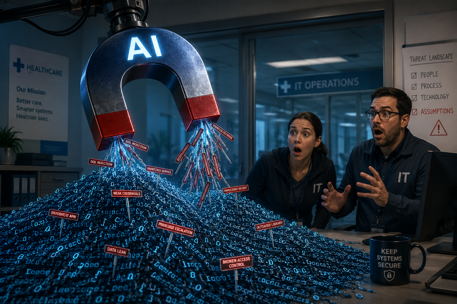
Think of it this way. In the past both sides of the constant battle for your data used to search for needles in haystacks manually. Now, AI comes in and it is like you brought industrial magnets and just sucked the magnets right out of the haystack.
We always say we treat the AI tools like really smart interns who just need a lot of direction. Well, the criminals are doing the exact same thing. Instead of one burglar checking windows one-by-one, now they have thousands of interns checking every window simultaneously. But, it isn’t just houses on your street, it is every door and window on any house in a large city all at one time. AI is becoming a force multiplier
We are simultaneously excited about AI and terrified about AI. Right now AI is still controlled by humans giving it tasks and it is working hard to make everyone happy with their work. Humans still direct the attacks. AI is just able to do it much faster and more thoroughly than ever before. Turns out giving everyone a supercharged research assistant includes the bad guys. Nobody reads the terms and conditions on technological revolutions. Or, if they do, they pay the same attention the rest of us do when we click through them.
Here are your bullets on this one:
- The bottom line is AI is becoming a force multiplier and accelerates the discovery of vulnerabilities.
- Faster discovery of vulnerabilities means less time to react.
- Healthcare organizations already struggle with patching and staffing shortages able to respond to these quickly.
The Disgruntled Researcher and Insider Risk
This story isn’t just about Microsoft vulnerabilities it highlights how much organizations rely on trust. But, there is constant debate about how much all parties should be trusted and for how long.
We rely on security researchers to find problems before our adversaries do. Researchers who do find a flaw in software will normally give vendors time to fix flaws before public release. Then, they release the vuln info along with details of a fix. In theory, keeping it quiet until you can fix it does make sense. But, it requires A LOT of trust. This case raises concerns because releasing details publicly before fixes exist can help attackers.
Let’s be clear on this topic. There are ongoing debates in cybersecurity about disclosure timelines and corporate responsiveness. There are cases where researchers have notified vendors and gotten crickets in response. Eventually, they have no choice but to release their findings to allow others to protect themselves.
But, it seems there is a serious situation if someone that understands the Microsoft systems to this level is actively releasing them without providing any notice. The details in these stories revolve around an anonymous security researcher who three Windows zero-days earlier this year making them public before MS had a patch. They have now revealed two more. I thought it was interesting that they did this release right after the Patch Tuesday release. I guess looking for them to be addressed and they weren’t but who knows. What is important to all of us is what they reported finding with this YellowKey (bypasses bitlocker encryption) and GreenPlasma (a privilege escalation flaw giving attackers SYSTEM level access).
“Nightmare-Eclipse described YellowKey as “one of the most insane discoveries I ever found.” They provided the files, which have to be loaded onto a USB drive, and if the attacker completes the key sequence correctly, they are granted unrestricted shell access to a BitLocker-protected machine.”
When the first round happened there was speculation that this “disgruntled researcher” is rumored to be a former Microsoft employee. For now, no one knows but it does give us a few things to consider.
- Sometimes, the person most dangerous to your organization may already have a badge.
- Staff frustration and resentment can become cybersecurity risks.
- Cybersecurity depends heavily on trust, and trust sometimes breaks.
BitLocker, YellowKey, and the Encryption Assumption
Healthcare organizations have long been able to assume encrypted laptops are effectively safe if stolen because no one can actually get the data. The breach notification exception has come in handy many times I am sure. But, if this information is really true…. Houston, we have a problem.
The good news is this appears to be a proof-of-concept attack and not “all encryption is broken” – at least not yet. But, it also can be a wake up call on how much you rely on just the encryption to protect you from someone getting physical access to your device.
Encryption is still essential, but no security control should be treated as invincible.
Let’s look at the big picture these 3 articles establish for us about past (and some current) assumptions:
- We assumed finding vulnerabilities would remain difficult.
- We assumed trusted experts would always act responsibly.
- We assumed encryption automatically meant safe.
What should you do with all of this information:
- Don’t panic
- Don’t assume
- Layer protections
- Patch quickly
- Monitor insiders
- Train employees
- Prepare for the possibility that trusted controls may eventually fail
Security controls reduce risk. They do not eliminate it. Modern cybersecurity risks are increasingly about broken assumptions, not just broken technology – and trust is one of the biggest assumptions built into how we handle technology, data, and even team relationships in healthcare. As tools like AI change the way vulnerabilities are discovered and exploited, it’s more important than ever to rethink old assumptions and shore up your defenses. This episode gets into why healthcare leaders, compliance teams, and anyone touching sensitive data should be keeping a close eye on these evolving risks. Give it a listen to catch the practical takeaways and keep your organization a step ahead.
Remember to follow us and share us on your favorite social media site. Rate us on your podcasting apps, we need your help to keep spreading the word. As always, send in your questions and ideas!
HIPAA is not about compliance,
it’s about patient care.TM
Special thanks to our sponsors Security First IT and Kardon.


