
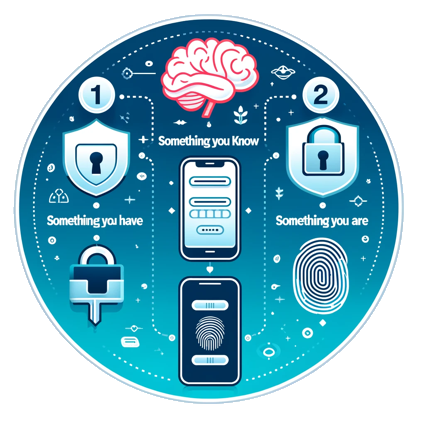
After the big cyberattack on Change Healthcare, there’s a hot debate about making Multi-Factor Authentication (MFA) a must-have for all public access points. With Congress getting involved and experts pushing for tougher security, it’s clear that better safeguards are needed to keep our healthcare data safe. This shift towards mandatory security measures shows just how serious cyber threats have become.
In this episode:
Time for mandatory MFA? – Ep 458
Today’s Episode is brought to you by:
Kardon
and
HIPAA for MSPs with Security First IT
Subscribe on Apple Podcast. Share us on Social Media. Rate us wherever you find the opportunity.
Great idea! Share Help Me With HIPAA with one person this week!
Learn about offerings from the Kardon Club
and HIPAA for MSPs!
Thanks to our donors. We appreciate your support!
If you would like to donate to the cause you can do that at HelpMeWithHIPAA.com
Like us and leave a review on our Facebook page: www.Facebook.com/HelpMeWithHIPAA
If you see a couple of numbers on the left side you can click that and go directly to that part of the audio. Get the best of both worlds from the show notes to the audio and back!
Thanks to our donors.
HIPAA Briefs
[06:20]Insight Global LLC, headquartered in Atlanta has agreed to pay $2.7 million to resolve allegations that it violated the False Claims Act by failing to implement adequate cybersecurity measures to protect health information obtained during COVID-19 contact tracing.
Time for mandatory MFA?
[13:34]Opening statements
Wyden Hearing Statement on Change Healthcare Cyberattack and UnitedHealth Group’s Response
Of note: US hospital network Steward files for bankruptcy, aims for new loan | Reuters
Steward has nearly 30,000 employees, including 4,500 primary and specialty care physicians, at 400 facility locations. Steward Health Care provides care to more than two million patients annually.
Steward filed for bankruptcy with between $1 billion and $10 billion in liabilities, according to its Chapter 11 petition filed in Houston, Texas bankruptcy court.
According to some of the articles they are in negotiations with Optum, a UHG subsidiary, to purchase their primary care physicians clinics.
Steward Health Care files for Chapter 11 bankruptcy | Healthcare Dive
UnitedHealth Group CEO takes bipartisan heat in Senate hearing over cyberattack | The Hill
Senate Finance Chair Ron Wyden (D-Ore.) made it clear straight out of the gate that he blamed Witty’s leadership for the cyberattack, which caused widespread disruptions to the health care sector.
Sen. Elizabeth Warren (D-Mass.) noted how UHG has “bought up every link in the health care chain,” owning “the country’s largest insurer, the country’s largest claims processor, the country’s third-largest pharmacy benefit manager.”
“You’re now in a position to jack up prices, squeeze competitors, hide revenues and pressure doctors to put profits ahead of patients. UnitedHealth is a monopoly on steroids,” said Warren.
Sen. James Lankford (R-Okla.) directly asked Witty when patients and providers would be “made whole” of the payments and services they have struggled to access since the attack.
“I would hope that that’s in the next month or six weeks,” Witty responded.
[38:34]1. Legacy tech at Change amplified attack’s impact
Before the attack, UnitedHealth, which acquired Change for $13 billion in late 2022, was in the process of upgrading and modernizing an extensive amount of Change’s technology.
2. Stolen credentials unlocked access
The company has relatively high confidence the credentials were stolen and sold on the dark web before the attack occurred.
3. Incident response cavalry called in
At least seven incident response firms and third-party cybersecurity experts to help it respond to and recover from the attack. Some of those engagements, all of which began after the attack, will now remain in place.
Witty specifically called out the support it received from Mandiant, Palo Alto Networks and Bishop Fox, but in written testimony added that Google, Microsoft, Cisco and Amazon were also on site assisting with recovery, advisory and testing efforts.
UnitedHealth asked Mandiant to join its board as a permanent advisor to strengthen the company’s cybersecurity oversight and strategy.
4. Response and recovery snags
Change’s legacy technology also meant the prime and backup IT environments were not isolated and both systems were directly impacted by the attack. IT elements in the cloud were brought back online quickly, but systems in older data centers were weighed down by multiple layers of old technology, Witty said.
5. Multifactor authentication wasn’t turned on
The company’s policy is to have MFA turned on for all external-facing systems, but for reasons that remain under investigation, a Change Healthcare Citrix portal used for desktop remote access did not have MFA turned on.
“We’re trying to dig through exactly why that server had not been protected by MFA. I’m as frustrated as anybody about that fact and we are working to try and understand exactly why it was not covered at the time,” Witty said.
“I can confirm to you that as of today, across the whole of UHG, all of our external-facing systems have got multifactor authentication enabled,” he said.
As we navigate the digital age, it’s becoming clear that stronger defenses like mandatory MFA aren’t just nice to have; they’re essential. With cyber threats on the rise and healthcare data constantly at risk, stepping up security measures isn’t just a precaution—it’s a necessity. By implementing mandatory MFA, we can ensure a higher standard of protection, making it much tougher for cybercriminals to cause havoc. It’s about time we take these steps to safeguard our data and regain confidence in our digital security systems.
Remember to follow us and share us on your favorite social media site. Rate us on your podcasting apps, we need your help to keep spreading the word. As always, send in your questions and ideas!
HIPAA is not about compliance,
it’s about patient care.TM
Special thanks to our sponsors Security First IT and Kardon.


