
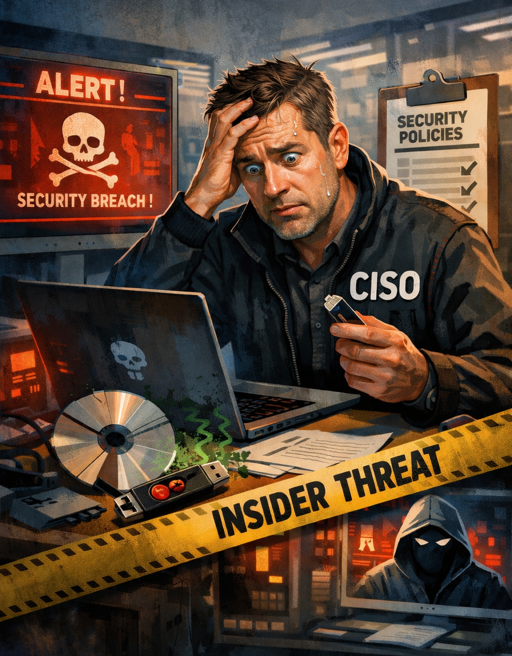
You’d think the folks steering the cybersecurity ship would be the last ones to punch holes in the hull—but nope, even the pros trip over their own policies. In this episode, we dive headfirst into a cautionary tale where a CISO (yes, the security guy) admits to becoming the insider threat he warns others about. From skipping his own software vetting procedures to triggering network alarms like it’s the 4th of July, this story is equal parts cringe and crucial. Strap in as we explore how even the most iron-clad experts are still deliciously human.
In this episode:
Even Security Leaders Make Human Mistakes – Ep 544
Today’s Episode is brought to you by:
Kardon
and
HIPAA for MSPs with Security First IT
Subscribe on Apple Podcast. Share us on Social Media. Rate us wherever you find the opportunity.
Great idea! Share Help Me With HIPAA with one person this week!
Learn about offerings from the Kardon Club
and HIPAA for MSPs!
Thanks to our donors. We appreciate your support!
If you would like to donate to the cause you can do that at HelpMeWithHIPAA.com
Like us and leave a review on our Facebook page: www.Facebook.com/HelpMeWithHIPAA
When you see a couple of numbers on the left side of the text below click that and go directly to that part of the audio. Get the best of both worlds from the show notes to the audio and back!
Even Security Leaders Make Human Mistakes
Peering into the NCA Crystal Ball: 2026 Cybersecurity Predictions You Should Know About
I am just as human as the users I protect.
Everyone operates under pressure, including CISOs, engineers, and security teams. Human behavior, convenience, and overconfidence remain central cybersecurity risks — now amplified by what’s coming next.
Quick framing of the CISO story as a reality check and preview that 2026 predictions say this problem is about to get worse, not better.
The CISO becomes the insider threat
[05:48] Recap of the personal mistake and shortcut:“The Mistake: I was working on a personal side project and needed a specific utility tool. Instead of going through our standard procurement and vetting process—which I helped write—I took a shortcut. I downloaded a “freeware” version from a third-party site.
Within 10 minutes, our EDR (Endpoint Detection and Response) flagged a suspicious DLL injection.
I hadn’t just downloaded a tool; I had invited a Trojan into our environment.”
The real kicker here—and it’s an important one—is that this is exactly how actual incidents begin. It’s rarely the clueless newbie or careless end user. More often, it’s a seasoned, well-intentioned professional who thinks, “Eh, I’ll just do this one thing real quick.” And boom: welcome to Incident Response Mode. This story reminds us that experience doesn’t grant immunity from bad decisions—it just gives you fancier ways to justify them.
Here’s what we tend to forget: the constant push for speed, multitasking, and “just get it done” mentality unintentionally trains people to skip the important stuff. It’s not just end users—security teams and leaders fall into the same trap. When urgency becomes the norm, risk awareness takes a back seat, and that’s when even the pros start ignoring their own playbooks.
“The Reality Check: I felt the blood drain from my face. I knew better. I’m the one who signs off on the “Shadow IT” reports. Yet, in a moment of “I just need to get this done,” I prioritized speed over the very guardrails I expect everyone else to follow.”
Where the NCA predictions come in: Humans stay central
[12:41] The National Cybersecurity Alliance (NCA) predicts that cyber threats will increasingly exploit human behavior, including they predict deepfakes will be impossible to spot. Here are a few more predictions:“The biggest breaches will still come from basic human missteps.”
Attackers will lean harder on social engineering and manipulation.
The idea that humans remain both the weakest and most targeted link.
“Cybersecurity training will focus on real behavior change.”
Convenience might be great for streaming your favorite show, but in cybersecurity, it’s the enemy with the best smile. The reality is that the more friction people encounter in secure processes, the more likely they are to go rogue. The National Cybersecurity Alliance points out that as tech adoption accelerates, especially with AI and faster tools, so does the risk. Why? Because layering speed on top of a poorly designed process doesn’t fix the friction, it just gets you to the mistake faster. If security isn’t built with usability in mind, people will continue to choose the path of least resistance… even if that path leads straight to a Trojan horse.
“Convenience is the Enemy of Security: Even for experts. If a process is too clunky, people (including me) will bypass it. We need to make the “secure way” the “easy way.””
And this right here is why the CISO’s response is more important than the mistake itself. He didn’t hide it, didn’t deflect blame, and didn’t try to flex his title to get out of trouble. Instead, he owned it fully and insisted on being treated like any other compromised user. That level of transparency and accountability sends a message louder than any policy memo: real leadership means walking the talk—even when it’s uncomfortable.
“Accountability is a Mirror: I called my SOC lead immediately. I didn’t pull rank. I asked them to treat my machine like any other compromised asset. If leadership is exempt from the rules, the rules don’t exist.”
Changes the CISO is making to how the team operates
[22:18]- Streamlining our software request portal to reduce “Procurement Friction.”
- Encouraging a “No-Shame” reporting culture – because the faster we know, the faster we fix.
- Security isn’t about being perfect; it’s about being resilient.
“For all of us, the fundamentals still matter. Keeping software up to date, using strong and unique passwords, enabling multifactor authentication, and being cautious with unexpected messages remain the most effective ways to protect yourself.”
Most importantly:
“In 2026, cybersecurity won’t be something you think about once a year. It will be an everyday part of daily online life.”
For all you tech folks out there you need to listen to the closing message:
“I am just as human as the users I protect.”
As our tale of cybersecurity self-sabotage draws to a close, one truth remains crystal clear: nobody’s too smart to be human. And when humans get rushed, stressed, or just plain tired of their own rules, mistakes happen – even Trojan-downloading, panic-inducing, I-thought-I-knew-better kind of mistakes. The silver lining? Transparency, accountability, and learning the hard way can lead to stronger systems and better habits. Just… maybe double-check before you click next time, yeah?
Remember to follow us and share us on your favorite social media site. Rate us on your podcasting apps, we need your help to keep spreading the word. As always, send in your questions and ideas!
HIPAA is not about compliance,
it’s about patient care.TM
Special thanks to our sponsors Security First IT and Kardon.


