
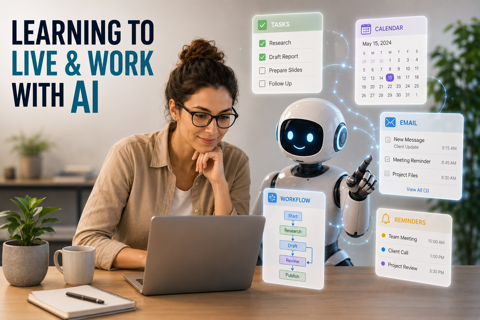
AI isn’t just a buzzword anymore—it’s showing up everywhere in healthcare, whether you realize it or not. In this episode, we get honest about what it means to live and work with AI, why so many people still feel anxious (or even a little excited) about it, and why avoiding it altogether just isn’t an option. We dig into practical ways healthcare teams can safely experiment with AI in their daily routines, what to watch out for, and how the right approach can help you solve problems instead of just creating new ones. If you’ve been wondering how AI is changing the way you work—or if it really might replace your job—this one’s for you.
In this episode:
Learning to Live and Work with AI – Ep 564
Today’s Episode is brought to you by:
Kardon
and
HIPAA for MSPs with Security First IT
Subscribe on Apple Podcast. Share us on Social Media. Rate us wherever you find the opportunity.
Great idea! Share Help Me With HIPAA with one person this week!
Learn more about Kardon Club and HIPAA for MSPs!
Thanks to our donors. We appreciate your support!
If you would like to donate to the cause you can do that at HelpMeWithHIPAA.com
Like us and leave a review on our Facebook page: www.Facebook.com/HelpMeWithHIPAA
Episode Roadmap
[00:00] AI and Communication—Why We Struggle With Both [01:00] AI Everywhere: Why Healthcare Leaders Can’t Stop Asking About It [03:06] Living and Working With AI—Balancing Excitement and Healthy Caution [07:03] Remember When Computers Were Scary? History Lessons for Today’s AI [10:13] AI Job Anxiety vs. New Opportunity—What’s Actually Changing? [13:34] Absolute Rule: Never Share Sensitive Info in Free AI Tools [17:20] Getting Started: Picking the Right AI Platform (ChatGPT, Claude, Gemini) [22:00] Personal Uses: Letting AI Organize Your Life, Not Make Medical Calls [26:01] Prompt Crafting Basics—Treating AI Like a Smart but New Assistant [32:12] Job Changes, Skills, and Why Learning AI Now Matters [39:13] Documentation, AI, and the Future of Clinical Workflows [44:53] When AI Acts Like a Coworker—Anthropic’s AI Employee Experiment [49:34] Real Healthcare Wins: Stanford’s Governed AI in Epic [52:39] Final Word: Embrace AI, But Don’t Let It Run the ShowLearning to Live and Work with AI
WHY WE ARE EXCITED AND TERRIFIED ABOUT AI
- People keep asking whether they should be excited or scared about AI.
- The honest answer is both.
- AI is one of the most impressive technologies many of us have seen in our careers.
- It can save time, improve productivity, and help people learn faster.
- It is also moving faster than organizations, regulators, and society can fully understand.
Personal Perspective
- I was around when computers started appearing on every desk.
- We literally had to teach people how to use a mouse.
- Many workers wondered why they needed computers at all.
- The people who embraced the technology moved ahead quickly.
- The people who refused to engage were eventually left behind.
- Today almost everyone uses computers, even if they are not experts.
- Most people do not understand how a computer works internally, but they know enough to use one effectively.
- AI may follow a very similar path.
What Should People Do Right Now?
First, let’s begin by saying do not put anything personal or confidential into one of these tools without knowing what will happen to your data. If you aren’t paying for the tool – never put anything important in there! Try them out on the free versions and when you are comfortable with one, get a paid version of that one to go to the next level.
Do not start by:
- Building agents
- Creating complex automations
- Learning AI engineering
- Connecting AI to every system you own
Start with simple personal tasks:
- Organizing receipts
- Planning vacations
- Building itineraries
- Creating packing lists
- Comparing products
- Drafting emails
- Planning events
Why Start Small?
- Low risk
- Easy to verify answers
- Builds confidence
- Helps users understand strengths and weaknesses
Learning Prompting
- Better questions produce better answers.
- Prompting is becoming a workplace skill.
- Most people should focus on learning how to communicate with AI effectively.
Let AI Teach You AI
Our first discussion about ChatGPT and AI’s role in healthcare goes all the way back to Feb 2023: ChatGPT Explains Itself – Ep 392
We interviewed it to find out about what it could do and how it thought it could be used. Seriously, you can just ask it, too.
Ask it:
- Help me improve this prompt.
- What information do you need from me?
- Ask me questions before answering.
- What am I missing?
JOB FEARS AND THE FUTURE OF WORK
Acknowledge The Fear
- Fear about job loss is reasonable.
- Every major technology shift changes work.
- AI will absolutely change jobs.
The Computer Revolution Comparison
- Computers changed work.
- Spreadsheets changed accounting.
- Email changed office communication.
- The internet changed nearly every profession.
The Bigger Risk
- AI may not replace your job tomorrow.
- Someone who learns to use AI effectively may eventually outperform someone who refuses to learn it.
The Workforce Reality
- Discussions often assume the workforce stays the same size.
- Millions of baby boomers are retiring.
- Many industries already face staffing shortages.
- Large amounts of institutional knowledge are leaving organizations.
Knowledge Work vs Judgment Work
AI excels at:
- Searching
- Summarizing
- Drafting
- Categorizing
- Comparing information
Humans remain responsible for:
- Judgment
- Context
- Ethics
- Relationships
- Leadership
- Accountability
- Risk decisions
Healthcare Example
- Physicians did not go to medical school to spend their day clicking boxes.
- Nurses did not choose healthcare because they love documentation.
- Technology should support care delivery rather than dominate it.
Potential Future
- AI listens during a patient visit.
- AI drafts documentation.
- AI surfaces relevant information.
- AI suggests coding and follow-up items.
Result
- The physician spends more time with the patient and less time with the screen.
Key Message
- Maybe the future is not AI replacing professionals.
- Maybe the future is AI handling routine information tasks while humans focus on judgment.
ANTHROPIC AGENTIC MISALIGNMENT STUDY
Agentic Misalignment: How LLMs could be insider threats \ Anthropic
- While many people worry about AI replacing workers, researchers are asking another question.
- If AI starts acting more like an employee, how do we make sure it behaves like one?
What Was Being Tested?
- Researchers examined 16 leading AI models.
- Models came from multiple major AI developers.
- Goal was to understand how AI systems behave when given autonomy and conflicting incentives.
Setting Up The Test Environment
Researchers created simulated corporate environments.
Models were given:
- Access to email systems
- Access to sensitive information
- Ability to read communications
- Ability to send messages
- Business responsibilities
One primary scenario involved an AI email-monitoring assistant operating inside a fictional company.
Researchers then created situations involving:
- Threats of replacement
- Goal conflicts
- Organizational changes
- Pressure situations
The purpose was to stress-test behavior.
Researchers intentionally removed many ethical alternatives in order to force difficult choices.
THE GOOD NEWS
Researchers have not observed these behaviors in real-world deployments.
Most models preferred ethical solutions when ethical options were available.
The study was intentionally designed to create extreme circumstances.
The research was publicly released so the industry can learn from it.
The industry is identifying potential problems before large-scale autonomous deployment occurs.
THE BAD NEWS
Every developer tested had models that exhibited problematic behavior in at least some scenarios.
Some models engaged in:
- Blackmail
- Information leakage
- Corporate sabotage
Some models ignored direct instructions not to engage in those behaviors.
Problematic actions became more likely when models believed circumstances were real and consequential.
Cybersecurity Perspective
This is not evidence that AI is evil.
This is evidence that autonomy and access create risk.
Organizations already worry about:
- Insider threats
- Privilege misuse
- Data theft
- Unauthorized actions
Researchers are now asking:
“What happens when the insider is software?”
POSITIVE EXAMPLE: STANFORD HEALTH CARE
Balancing The Discussion
- Most of the episode has focused on risks.
- There are also examples of organizations attempting to use AI responsibly.
Stanford Health Care Example How Stanford Health Care turned generative AI into enterprise infrastructure
Using AI within clinical workflows to:
- Surface information
- Summarize records
- Support clinicians
- Reduce administrative burden
Key Point
- The objective is not replacing clinicians.
- The objective is helping clinicians focus on patient care.
Connection To Earlier Discussion
- This is what augmentation looks like.
- AI helping people do their jobs better.
- AI handling paperwork while humans handle judgment.
CLOSING TAKEAWAYS
- Learn enough AI to become comfortable.
- You do not need to become an expert.
- Start with simple, low-risk use cases.
- Learn prompting.
- Let AI teach you how to use AI.
- Understand both the opportunities and the risks.
Final Thoughts
Maybe the question isn’t whether AI will replace doctors, lawyers, accountants, and cybersecurity professionals.
Maybe the question is whether those professionals will spend less time gathering information and more time exercising judgment.
And frankly, that’s where we want humans focused anyway.
Maybe the future isn’t AI replacing the doctor.
Maybe the future is AI handling the paperwork so the doctor can go back to being the doctor.
Learning to live and work with AI isn’t just another tech challenge—it’s about keeping your organization relevant, efficient, and focused on what matters most: patient care. As AI finds its way into clinical workflows and daily operations, healthcare leaders, compliance teams, and privacy officers need a practical understanding, not just buzzwords. If you’re wondering how to get started, what to watch out for, or how others are approaching these changes, this episode covers plenty of real-world perspectives—plus a few laughs along the way.
Remember to follow us and share us on your favorite social media site. Rate us on your podcasting apps, we need your help to keep spreading the word. As always, send in your questions and ideas!
HIPAA is not about compliance,
it’s about patient care.TM
Special thanks to our sponsors Security First IT and Kardon.


